
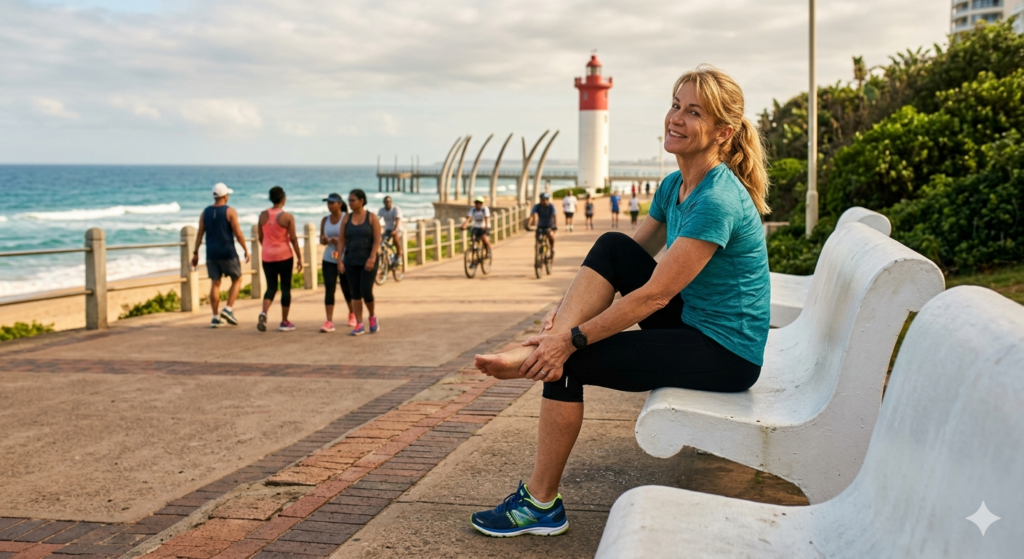
If you are reading this while sitting on one of those iconic whale-bone benches, massaging the arch of your foot and staring longingly at the lighthouse, welcome to the club. My name is Keshri Fuchs, and after 30 years of practicing physiotherapy, I finally decided to personally “research” one of the most common complaints I treat.
How? By developing a stubborn case of Plantar Fasciitis myself.
Even with three decades of clinical experience, the Umhlanga Promenade is a siren song I can’t resist. I’m out there five days a week, just like you, soaking up the salt air and the Indian Ocean views. But lately, that first step onto the paving feels less like a “zen morning stroll” and more like stepping onto a stray Lego brick.
If your morning walk has turned into a morning limp, let’s talk about why your feet are protesting and how we can get you back to your personal best without losing your Vitamin Sea.
The “Ouch” Factor: What is Plantar Fasciitis?
In the simplest terms, your plantar fascia is a thick web of tissue that connects your heel bone to your toes. It’s your foot’s built-in shock absorber. Every time you push off to pass a slow-moving group of tourists or navigate the incline near the pier, that tissue stretches.
Plantar Fasciitis occurs when that tissue gets irritated, inflamed, or develops tiny micro-tears.
Why the Promenade?
Our beautiful promenade is a blessing, but for a foot with fasciitis, it’s a bit of a “hard truth.”
-
The Surface: While the paving is smooth and scenic, it is unforgivingly hard. Unlike a forest trail or a soft beach, there is zero “give.”
-
The Geometry: We tend to walk long, linear distances on the promenade. Repetitive motion on a flat surface is the primary trigger for overuse injuries.
-
The View: Honestly, it’s so pretty that we often walk further than our “cold” tissues are ready for. We tell ourselves “just to the lagoon and back,” and suddenly we’ve clocked 6km on a grumpy heel.
The Honest Truth: From a Physio (and a Patient)
Here is the “honest” part of this article: Healing takes time. As a physio of 30 years, I want to tell you there is a magic wand. As a fellow sufferer walking the same promenade as you, I know that the road to recovery isn’t a sprint; it’s a steady, mindful walk.

When you have that sharp, stabbing pain with your first steps in the morning, your body is sending a flare signal. It’s not telling you to stop moving forever; it’s asking you to change how you move.
The “Sporty & Fun” Recovery Plan
We live in Umhlanga—we’re an active bunch! We don’t want to sit on the sidelines. Here is how I am treating myself (and how I treat my patients) so we can keep our “Promenade Status” active.
1. The “Ice-Cold” Roller
After your walk, don’t just grab a coffee at the village. When you get home, grab a small plastic bottle of water that you’ve frozen. Roll your arch over it for 10 minutes. It provides a double whammy: Cryotherapy to reduce inflammation and a Deep Tissue Massage to stretch the fascia.
2. The “Umhlanga Curb” Stretch
You don’t need a gym. Use the curbs along the beach road.
-
Drop your heel off the edge of the curb while keeping the ball of your foot on the pavement.
-
Hold for 30 seconds.
-
Pro Tip: Don’t bounce! We want a long, lean stretch, not a rhythmic tug-of-war with your calf muscles.
3. Check Your “Tires”
Would you drive a Ferrari on bald tires? Of course not. If your walking shoes have seen more than 500–800km, the internal support has likely collapsed. If you’re walking the promenade 5 days a week, you’re hitting those numbers faster than you think. A fresh pair of shoes with proper arch support is the cheapest “medicine” you can buy.
4. The “Short-Foot” Exercise
While you’re waiting for your flat white at your favorite local café, try this: keep your foot flat on the ground and try to “shorten” it by lifting your arch without curling your toes. It’s like a bicep curl for your foot. Strengthening the intrinsic muscles of the foot takes the load off the fascia.
The Physio’s Golden Rule: Listen to the “After-Burn”
A common mistake is thinking, “It felt fine while I was walking!” With Plantar Fasciitis, the pain is often delayed. You might feel great while the blood is pumping and you’re enjoying the breeze, but the real test is how you feel two hours later or the next morning. If you’re hobbling the next day, you overdid it. Scale back the distance by 20%, get the inflammation under control, and then build back up. Consistency beats intensity every single time.
Why Come See Us in Umhlanga?
You might wonder why a physio with 30 years of experience needs to treat herself. It’s because we all have blind spots! Sometimes you need an objective eye to look at your gait, your hip alignment, or your calf flexibility.
At my practice here in Umhlanga, we don’t just look at the heel; we look at the whole “kinetic chain.” Often, a sore foot is actually a “lazy glute” problem or a “tight lower back” problem in disguise.
What we offer:
-
Biomechanical Analysis: Let’s see how you actually move.
-
Customized Loading Programs: Science-based exercises to make your fascia “tough” again.
-
Hands-on Therapy: To release the stubborn tension that stretching alone can’t reach.
-
Honest Advice: No gimmicks. Just 30 years of clinical wisdom applied to your specific lifestyle.
See You on the Prom!
Don’t let Plantar Fasciitis steal your joy. Umhlanga is too beautiful to view from a window. Whether you are a “Silver Walker” enjoying the sunrise or a weekend warrior training for a marathon, your feet deserve to feel as good as the view looks.
Next time you see a blonde physio (that’s me!) walking with a slightly more purposeful stride and perhaps stopping for a quick calf stretch against a railing—come say hi!
Let’s get those heels healed and keep our promenade culture alive.
Keshri Fuchs Physiotherapy
Empowering your movement in the heart of Umhlanga.
[Link to Website] | [Contact Number] | [Practice Address]
Disclaimer: This article is for informational purposes and reflects my personal and professional journey. For a formal diagnosis and treatment plan tailored to your body, please book a consultation at the practice.